

A power outage feels very different when your park model is in a rural area, a seasonal community, or a location that regularly sees storms. The refrigerator, lights, internet, water system, and heating or cooling equipment can all depend on one electrical connection.
That is why backup power is worth thinking about before your park model arrives.
The best solution is not automatically the biggest generator or the largest battery you can afford. It depends on what you want to keep running, how long outages normally last, whether fuel is easy to store, whether noise is allowed, and how your park model will be connected at the site.
If you are buying a park model now, this guide will help you compare the three most common approaches: a fuel-powered generator, battery backup, and solar paired with battery storage.
Quick Answer: Which Backup Power Option Is Best?
For short outages where you mainly need lights, refrigeration, internet, and device charging, a battery backup can be the simplest and quietest option.
For longer outages or higher electrical loads, a generator is often easier to keep running because you can refuel it.
For buyers who expect frequent outages, want more energy independence, or plan to use a remote site, solar paired with battery storage can provide a more resilient long-term setup.
For many buyers, the strongest solution is a hybrid system. A battery handles short outages quietly, while a generator provides backup when an outage lasts longer than the battery or available solar can support.
Before Choosing Equipment, Decide What Must Stay On
Start with the loads that actually matter during an outage.
For many park model buyers, that list may include:
- Refrigerator
- A few interior lights
- Phone and laptop charging
- Wi-Fi router or modem
- Television
- Water pump, if the site uses one
- Medical equipment
- Selected kitchen appliances
- Heating or cooling, depending on climate
Trying to back up every circuit can make the system much larger and more expensive than necessary.
There are two numbers that matter when sizing backup power.
Power, measured in watts or kilowatts, tells you how much equipment can run at the same time.
Energy, measured in watt-hours or kilowatt-hours, tells you how long the battery can support those loads.
For example, if your essential equipment averages 400 watts and you want eight hours of backup:
400 watts × 8 hours = 3,200 watt-hours, or 3.2 kWh.
Real systems need additional capacity for conversion losses, battery reserve, and equipment that briefly draws extra power when starting. Refrigerators, pumps, and air conditioners can have higher startup demand than their normal running load.
Use the actual appliance specifications in the park model you are buying rather than sizing from a generic online estimate.
Option 1: Using a Generator for Park Model Backup Power
A generator creates electricity as long as it has fuel. For buyers worried about multi-day outages, that is its biggest advantage.
A portable generator can be a practical choice when the park model is normally connected to shore or utility power but needs emergency backup during storms or grid failures.
Where a Generator Makes Sense
A generator may fit your situation if:
- Outages can last a day or longer
- You want to run higher-demand appliances
- You can safely store and access fuel
- Generator noise is allowed at your site or community
- You want substantial backup output without buying a large battery bank
Portable generators are available in gasoline, propane, and dual-fuel configurations. The right fuel depends on availability, storage rules, and how often you expect to use the generator.
What Buyers Often Miss
Do not choose a generator only by looking at its advertised maximum wattage.
You need to know:
- Continuous running watts
- Starting or surge watts
- Which circuits you actually want to power
- Whether a transfer switch, interlock, or dedicated generator inlet will be used
- Where the generator can be safely placed
- Whether your community has generator-hour or noise restrictions
If you want the generator connected to the park model’s electrical system rather than plugging individual devices directly into it, the connection should be planned correctly. Never backfeed a park model by plugging a generator into a standard wall receptacle.
Generator Safety Is Part of the Buying Decision
Fuel-powered generators produce carbon monoxide.
The U.S. EPA and NFPA recommend operating portable generators outdoors and at least 20 feet away from buildings, doors, windows, and vents. Exhaust should be directed away from the home, and working carbon monoxide alarms are essential.
That means the site itself matters. A generator is not a good plan if you have nowhere to operate it safely.
If you are preparing the property before delivery, include backup-power placement in your park model site preparation plan rather than deciding where the generator will go after everything is installed.
Option 2: Battery Backup for a Park Model
Battery backup stores electricity and releases it when you need it. Depending on the system, the battery may be charged from the grid, solar panels, or another power source.
For park model buyers, battery systems generally fall into two categories:
- Portable power stations that can run selected devices
- Permanently installed battery systems connected to selected circuits or the home’s electrical system
Battery backup is especially attractive when quiet operation matters.
Where Battery Backup Makes Sense
A battery may be a strong fit if:
- Most outages are relatively short
- You mainly want to protect essential loads
- Your park or community restricts generator noise
- You do not want to store fuel
- You want backup power that can be available quickly
- You want to add solar later
Batteries also require much less day-to-day attention than a fuel generator. There is no engine to start and no fuel to refill during a short outage.
The Main Limitation Is Runtime
A battery stores a fixed amount of energy.
If you are running lights, a refrigerator, a router, and a few devices, the stored energy may last much longer than if you are also trying to run an electric water heater, cooking equipment, or air conditioning.
This is particularly important for buyers in hot climates.
A mini-split can be efficient, but cooling is still a major electrical load. If keeping air conditioning running during an outage is essential, include the exact HVAC specifications when sizing the battery and inverter. Our mini-split sizing guide explains why cooling requirements vary even in a compact park model.
A battery that is excellent for six hours of essential loads may be completely inadequate for an overnight outage with continuous cooling.
Option 3: Solar Plus Battery Storage
Solar is attractive because sunlight can replenish stored energy without requiring a fuel delivery.
However, there is an important detail many buyers miss:
Solar panels by themselves do not automatically provide backup power when the utility grid goes down.
Most conventional grid-tied solar systems are designed to shut down during a grid outage. To provide power independently, the system needs compatible equipment that can operate safely when disconnected from the grid, typically including the right inverter, controls, and battery storage.
For this reason, when we talk about “solar backup” for a park model, we are really talking about solar plus storage.
Where Solar Plus Battery Makes Sense
This setup can work well if:
- You are planning a remote or semi-off-grid site
- Outages are frequent
- You want the battery to recharge during a longer outage
- The site receives useful sunlight
- You have suitable roof or ground space for panels
- The local park, community, or property rules allow the installation
- You are willing to invest more upfront for a longer-term energy system
Solar is especially useful when the park model may sit in a location where fuel deliveries or grid restoration could be delayed.
What Solar Does Not Solve by Itself
Solar production changes with:
- Time of day
- Cloud cover
- Season
- Shade
- Panel orientation
- Available panel are
A solar array should not be sized only around a sunny summer afternoon.
If you want reliable backup, you need enough battery storage to bridge periods when solar production is low and enough solar capacity to replace the energy you use.
That is why a proper load calculation is more valuable than buying panels first.
Generator vs. Battery vs. Solar: Which Fits Your Park Model?
Here is a practical way to think about the decision.
If You Expect Occasional Short Outages
Choose: Battery backup.
A properly sized battery can keep your refrigerator, lights, internet, and small electronics working without generator noise or fuel.
If You Expect Long Storm Outages
Choose: Generator or hybrid.
A generator can keep producing power as long as fuel is available. A battery can make the system more comfortable by handling overnight or low-load periods quietly.
If You Are Planning an Off-Grid or Remote Park Model
Choose: Solar plus battery, usually with generator backup.
Solar can handle regular daily energy production while the battery stores energy for nighttime use. A generator provides another layer of protection during prolonged bad weather or unusually high usage.
If Your Site Has Strict Noise Rules
Choose: Battery or solar plus battery.
Some parks and communities limit generator use, particularly at night. Check the rules before purchasing equipment.
If You Need Air Conditioning During an Outage
Choose: A professionally sized generator, large battery system, or hybrid setup.
Do not assume a portable battery that runs a refrigerator can also support your cooling system for hours. HVAC changes the power and energy calculation significantly.
If You Only Need Emergency Essentials
Choose: A smaller battery system or portable generator.
There is usually no reason to pay for whole-home backup if your real goal is to keep food cold, phones charged, a few lights on, and your internet connection available.
Plan Backup Power Before Your Park Model Is Delivered
The best time to think about backup power is while you are planning the site.
Before delivery, ask these questions:
- What electrical service will my specific park model require?
- Which appliances and systems do I want available during an outage?
- Is the site connected to public utilities, an RV pedestal, or an off-grid system?
- Will a well pump, septic equipment, or other site equipment also require backup power?
- Do I want selected critical circuits backed up or the entire electrical panel?
- Where can a generator or battery system be safely installed?
- Does the community allow generators, solar panels, or exterior battery equipment?
- Will I need an electrical permit, solar permit, or other local approval?
- Should a generator inlet, transfer equipment, critical-load panel, or solar-ready wiring be planned before the site is finished?
- Who will be responsible for the final electrical connection?
These questions belong beside your foundation, utility, and delivery planning. Our site preparation guide and permit guide can help you think through the other items that need to be ready before the home arrives.
Do Not Forget Community Rules and Local Codes
Park models can be placed in very different settings. A private rural property may allow equipment that an RV resort or planned community does not.
Before purchasing a generator, solar array, or permanently installed battery system, verify:
- Local electrical requirements
- Permit requirements
- Park or community rules
- Generator hours and noise limits
- Solar installation restrictions
- Equipment placement requirements
- Utility interconnection requirements where applicable
A technically suitable system is not useful if the site rules prevent you from installing or operating it.
Is a Hybrid Backup System Worth It?
For buyers who want more resilience, a hybrid setup can solve the weaknesses of using only one power source.
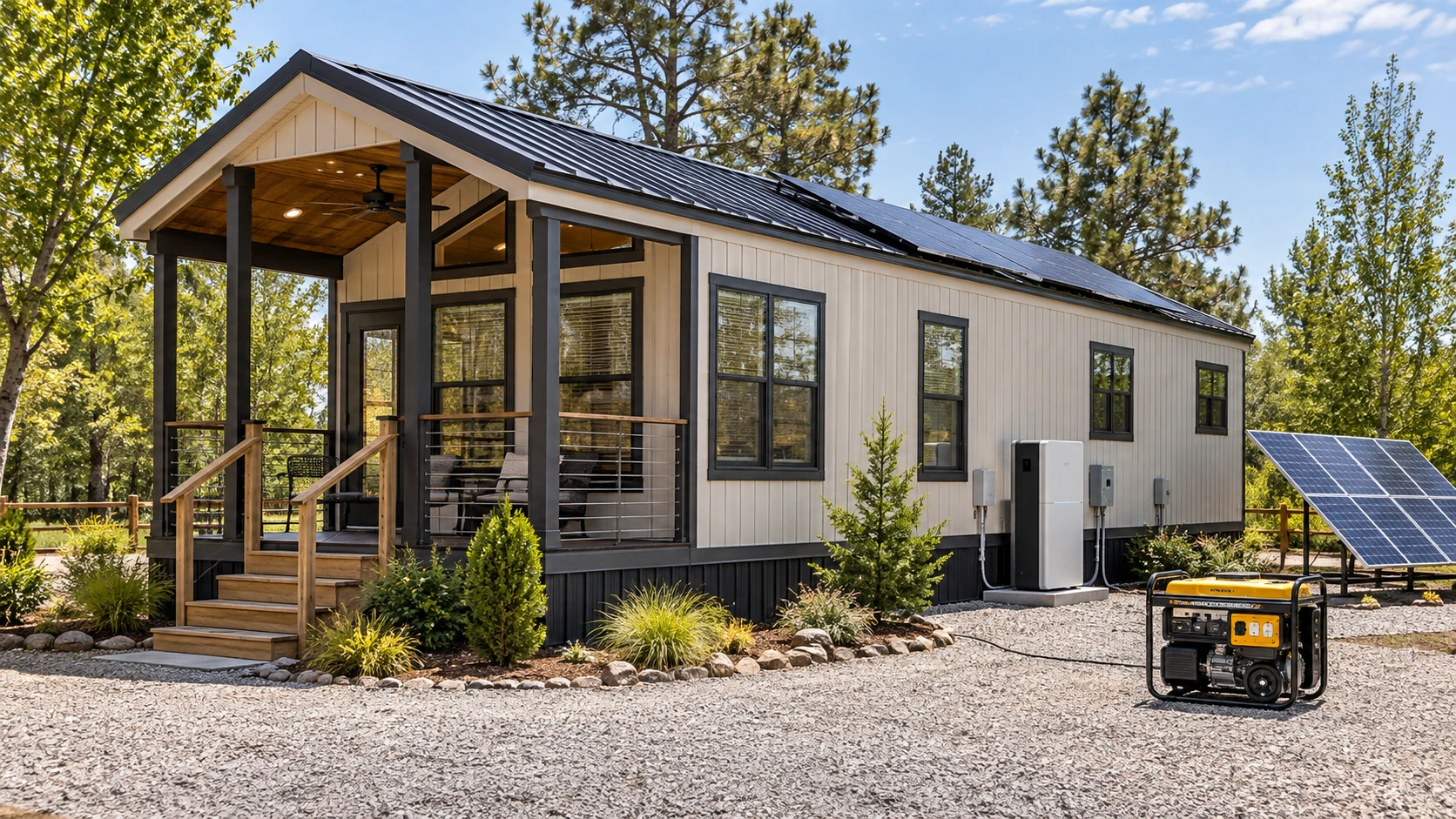
A battery can provide quiet backup immediately when the grid fails. Solar can recharge the battery during the day. A generator can support the system when the outage continues through poor weather or when electrical demand is unusually high.
This does not mean every park model needs all three.
It means buyers with frequent outages should think in layers:
Primary power: Utility, pedestal, or solar system
Short-term backup: Battery
Extended backup: Generator and/or continued solar charging
The right combination depends on the site and how critical uninterrupted power is for you.
Final Takeaway
There is no single best backup power system for every park model.
A generator is strong when you need high output or long runtime.
A battery is strong when you want quiet, convenient backup for essential loads.
Solar paired with storage is strong when you want the battery to recharge and you are planning for frequent outages, remote use, or greater energy independence.
The most important step happens before you buy any of them: decide what needs to stay powered and for how long.
If you are still choosing your park model, review the electrical features of the model, your site utility plan, and the backup system together. That can prevent expensive changes after delivery and help you build a setup that matches the way you actually plan to use the home.
Explore Phoenix Park Model floor plans and discuss your planned site and electrical needs before placing your order.
FAQs
Can You Run a Park Model on a Generator?
Yes, a properly sized generator can supply backup power to a park model. The correct size depends on the equipment you plan to run, including startup loads. If the generator will connect to the park model’s wiring, use properly installed transfer equipment and follow local electrical requirements.
Can a Battery Backup Run a Park Model Air Conditioner?
It can, if the inverter can handle the air conditioner’s running and startup demand and the battery has enough usable energy. The larger question is runtime. Cooling can consume a significant share of stored energy, so use the exact HVAC specifications when sizing the system.
Will Solar Panels Power a Park Model During an Outage?
Not necessarily. Most standard grid-tied solar systems shut down when the grid is down. Outage backup generally requires a properly configured inverter and storage system that can operate independently from the grid.
How Much Battery Storage Does a Park Model Need?
There is no universal number. Add the wattage of the loads you need to run and multiply by the number of hours you want them supported. Then allow for startup demand, system losses, and reserve capacity. A qualified installer can turn that load list into a final system size.
Can I Use Solar and a Generator Together?
Yes. A hybrid system can use solar to recharge batteries during daylight and a generator as backup when solar production is low or the outage lasts longer than expected.
Should I Plan Backup Power Before Buying the Park Model?
Ideally, yes. Planning early makes it easier to coordinate electrical service, equipment location, generator connections, critical circuits, solar wiring, and site permits before the park model is installed.