

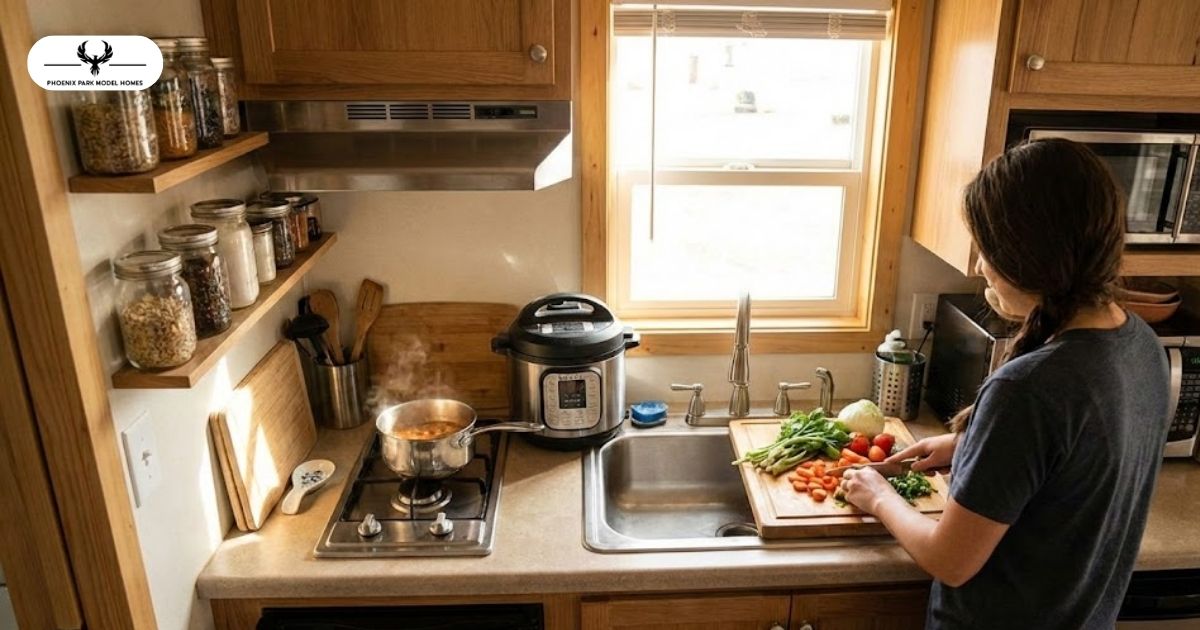
Let me guess, you walked into your park model kitchen for the first time, looked around, and thought, “How am I supposed to cook Thanksgiving dinner in here?”
I get it. Park model kitchens are cozy. That’s the polite word for it. What they actually are is small. You’ve got maybe eight feet of counter space if you’re lucky, a two-burner stove or a small four-burner if you upgraded, and a fridge that holds about as much as a college dorm room.
But here’s what nobody tells you: some of the best meals you’ll ever make will come out of that tiny kitchen. Once you figure out how to work with the space instead of against it, cooking in a park model can actually be kind of great.
Let me show you how to make it work.
The Space Isn’t the Problem-Your Expectations Are
First things first. Stop trying to cook like you did in your old house.
You’re not making five side dishes for Sunday dinner anymore. You’re not storing three weeks of groceries. You’re not going to have every gadget and appliance you used to own.
And that’s okay. Actually, it’s more than okay; it’s kind of freeing once you adjust.
Think of your park model kitchen like a galley kitchen on a boat. Commercial chefs work in tight spaces all the time and create amazing food. Your tiny kitchen just means you need to be a little more thoughtful about what you’re doing.
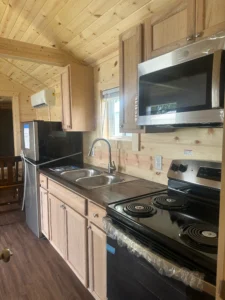
The good news? Cooking for two people (or even four) in a park model is totally doable. You just need some different strategies than you’re used to.
Counter Space Is Gold
Let’s talk about the most valuable real estate in your kitchen, that little bit of counter space you’ve got.
Most park models have counter space on either side of the sink, maybe a little section by the stove, and that’s about it. You might have 30 to 40 inches total. Not much.
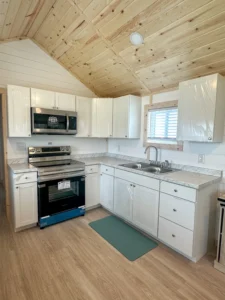
So you can’t leave stuff sitting out. That coffee maker that lived on your counter for ten years? It needs to go in a cabinet now. The knife block, the fruit bowl, the mixer, all that stuff needs homes inside cabinets, or it’ll take over.
Keep your counters as clear as possible when you’re not cooking. When you are cooking, you’ll need every inch for prep work.
Here’s a trick: get a cutting board that fits over your sink. You can find these at kitchen stores or online. It basically gives you a temporary counter extension right when you need it most. Just make sure it’s stable, you don’t want it sliding around while you’re chopping onions.
Some people also use fold-down cutting boards that attach to the wall or cabinet. They flip up when not in use and give you extra prep space when you need it.
And don’t forget about your stove. When the burners aren’t hot, the stovetop is just more counter space. You can set things there while you’re prepping. Just remember to move everything before you turn on the heat. Ask me how I know this matters.
Your Appliances Need to Multitask
You can’t have every appliance you might want, so choose ones that do multiple jobs.
An Instant Pot or similar pressure cooker is basically mandatory for park model living. It pressure cooks, slow cooks, sautés, steams, and makes rice. That’s five appliances in one, and it only takes up one burner or one spot on your counter.
A toaster oven that can also air fry and convection bake is another good investment. It heats up faster than a full oven, uses less energy, and for two people, it’s usually big enough for what you’re making.
If you’ve got a two-burner stove, an electric skillet or griddle becomes your third burner. You can make pancakes, fry chicken, or cook stir-fry in it. It lives in a cabinet when you’re not using it.
A good blender that can also food process is better than having both a blender and a food processor taking up space.
What you probably don’t need: a stand mixer (hand mixer works fine for small batches), a rice cooker if you have an Instant Pot, a waffle maker unless you’re really into waffles, or any single-purpose gadget that you’ll use twice a year.
Storage Solutions That Actually Work
Cabinet space in a park model is limited, so organization matters way more than it did before.
Stackable storage containers are your friends. Those random mismatched Tupperware containers you’ve collected over the years? They’ve got to go. Get a set of containers that stack neatly and use the same lids.
Use the vertical space inside cabinets. Shelf risers let you create two levels where you used to have one. Suddenly you can fit twice as many plates or cans in the same cabinet.
Door-mounted organizers work great for spices, wraps, or cleaning supplies. That inside cabinet door space usually just sits there wasted.
Under-sink organizers with pull-out drawers or shelves make that awkward space much more useful. You can actually reach things in the back instead of playing cabinet Tetris every time you need dish soap.
Magnetic knife strips mounted on the wall free up drawer space and keep your knives accessible. Same with magnetic spice tins on the side of your fridge if you’ve got metal surfaces.
And here’s a weird trick: hang a shoe organizer on the inside of your pantry door if you have one. Those pockets are perfect for snacks, seasoning packets, or small items that get lost in cabinets.
Meal Planning Becomes Actually Important
In a regular kitchen, you can be spontaneous. Oh, I’ll make lasagna tonight! Who cares if you don’t have ricotta? Just run to the store.
In a park model, being spontaneous is annoying because you don’t have space to store ingredients for every possible meal you might want to make. Your fridge and pantry are small, so what you have on hand actually matters.
This is where meal planning stops being optional and starts being smart.
Before you go grocery shopping, plan out what you’re making for the next few days. Then buy only what you need for those meals, plus a few basics.
One-pot meals become your best friend. Soups, stews, pasta dishes, stir-fries, casseroles, anything where you’re cooking everything together in one pot or pan. Less cookware to juggle on limited burner space, less cleanup, and usually great leftovers.
Sheet pan dinners are also perfect for park model living. Throw protein and vegetables on a baking sheet, season everything, and roast it. One pan, minimal cleanup, and it works great for two people.
Prep ingredients right after shopping if you’ve got time. Chop vegetables, portion meat, mix sauces. Store everything in containers so when it’s time to cook, you’re just assembling and heating rather than doing everything from scratch in a cramped space.
The Two-Burner Stove Challenge
If you’ve got a four-burner stove, skip this section. But lots of park models come with just two burners, and cooking on two burners requires some strategy.
You can’t have four pots going at once like you might be used to. So you either need to cook in sequence or find ways to consolidate.
For example, if you’re making pasta with meat sauce, cook the meat first, set it aside, then boil the pasta in the same pot you’ll use for the sauce. One burner for everything.
Or use that Instant Pot I mentioned. It becomes your third burner, handling rice while you’ve got vegetables on one burner and protein on the other.
Embrace the microwave for things it does well, such as steaming vegetables, reheating sides, or even baking a potato. It’s not cheating, it’s working smart.
And timing matters more. Think through what needs to cook when. Get your rice going first since it takes a while, then start the quick-cooking stuff.
Fridge and Freezer Tetris
Park model refrigerators are apartment-sized at best. You’re looking at maybe 10 cubic feet compared to the 20+ cubic feet you might have had before.
This means you can’t stock up on everything. No buying three gallons of milk because it’s on sale. No keeping six types of salad dressing around because different people like different things.
Buy smaller quantities more often. It feels inefficient, but it’s better than trying to cram everything into a tiny fridge.
Use clear containers so you can see what you have without digging. If you can’t see it, you’ll forget about it, and then it’ll go bad in the back of the fridge.
Freeze what you can. Bread, meat, and even milk freeze fine. Your freezer is small too, but it’s valuable space for extending the life of food.
Keep leftovers in mind when cooking. One meal’s leftovers become tomorrow’s lunch, which means you need less fridge space for separate lunch ingredients.
And here’s something nobody thinks about until it becomes a problem: where are you going to put the Thanksgiving turkey? If you’re hosting any holiday meals, plan ahead. You might need to borrow someone’s fridge space, or pick up the turkey the same day you’re cooking it.
Hosting Dinner Without Losing Your Mind
So what happens when you want to have people over? Your park model kitchen can handle cooking for four or even six people, but you need a game plan.
Buffet-style is your friend. Set everything out on your small dining table or on the counter, and let people serve themselves. You don’t have room for plated dinners at the table anyway.
Make dishes that hold well or can be served at room temperature. You can’t keep four hot dishes warm simultaneously in a tiny kitchen, so work with that reality.
Prep absolutely everything you can in advance. Chop vegetables the night before. Mix sauces early in the day. Set the table an hour before anyone arrives. When guests show up, you should basically just be heating and assembling.
Use your outdoor space if you have it. A grill or outdoor burner gives you extra cooking capacity. You can do the protein outside while the sides cook inside.
And honestly? It’s okay to ask guests to bring something. Most people appreciate contributing, and it takes pressure off you trying to produce a feast from a tiny kitchen.
The Cleanup Reality
Small kitchens get messy fast. Like, really fast. Three dirty bowls, and suddenly you can’t see your counter.
The trick is to clean as you go. Got a minute while something’s simmering? Wash those bowls. Waiting for water to boil? Wipe down the counter.
If you let dishes pile up, you’ll run out of workspace immediately. Keep the sink as clear as possible while cooking.
A drying rack that fits over the sink or a fold-down dish rack helps, since you probably don’t have tons of counter space for letting things air dry.
And embrace paper plates for some meals. Yeah, it’s not eco-friendly, but sometimes you just don’t have the energy to wash dishes in a tiny sink after cooking. That’s okay.
It Gets Easier
Here’s the truth: the first few weeks of cooking in a park model kitchen can be frustrating. You’ll reach for a pan that’s not there. You’ll wonder where to put the cutting board while the stove is going. You’ll burn something because you forgot you only have two burners.
But then something shifts. You figure out your rhythm. You learn what works and what doesn’t. You discover that you actually like the simplicity of it.
Some of the best meals I’ve had came from park model kitchens. Not because the kitchens were fancy, but because the people cooking in them had figured out how to make them work.
Your park model kitchen isn’t worse than a big kitchen. It’s just different. And different can be really good once you stop fighting it.
So take a breath, clear those counters, and start cooking. You’ve got this.